41. Going Home
On summer camp, imagination, and a bunch of other things...

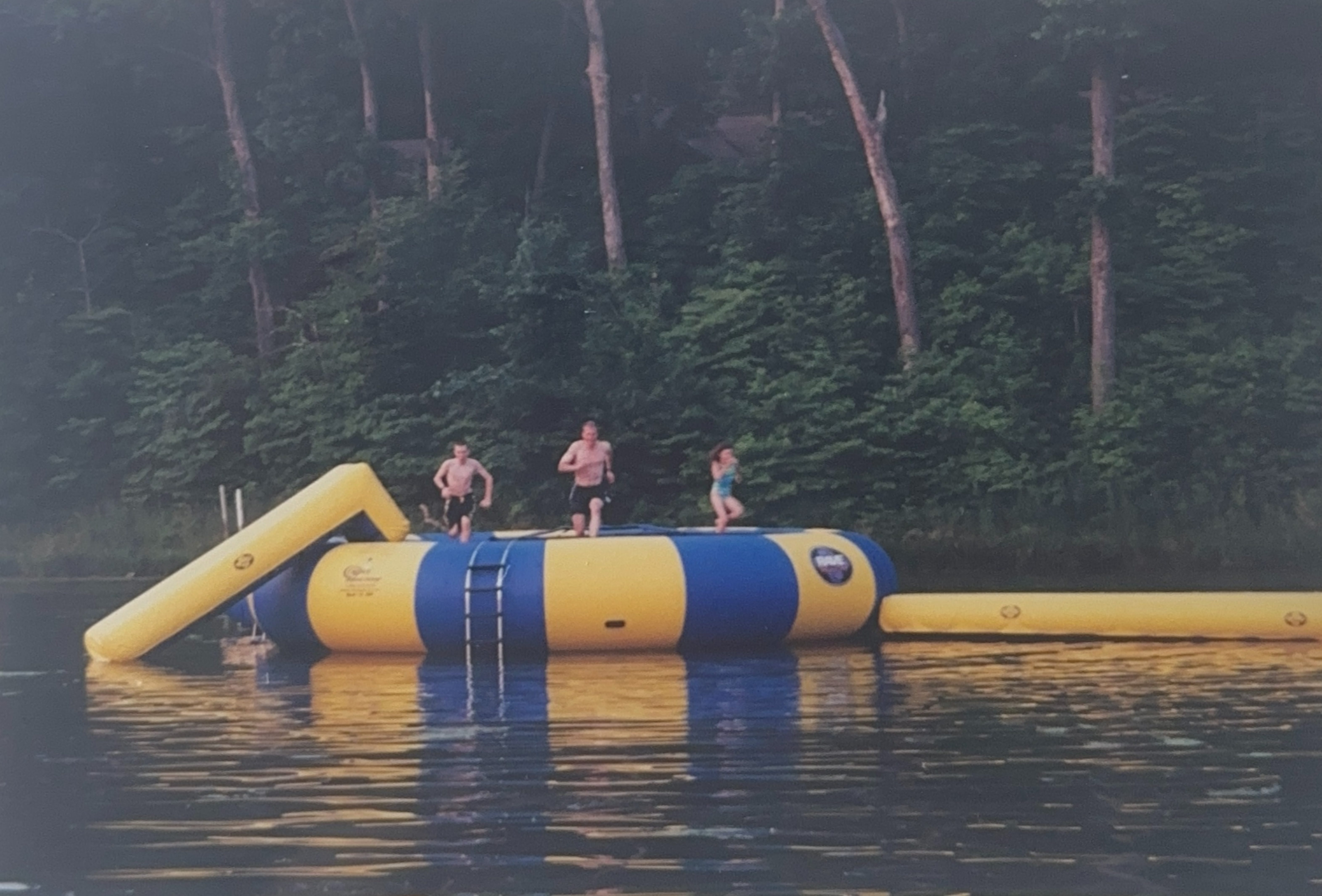
I have a new essay out this week over at Untapped Journal and I think its the most personal writing I've ever published. It's about my experience living on a summer camp for two and half years when I was a child. I've sketched out the contours this time in my life before over the last few years but never this directly. Here's how it opens:
About 80 miles northwest of Indianapolis, Indiana’s capital and largest city, the Tippecanoe River bends tightly back on itself, creating a small valley surrounded by water. One hundred years ago, 30 acres of this undeveloped land were sold by a local farmer to the nearby town of Delphi, for $3,000, so that a summer camp could be built there.
Summer camps, alongside urban playgrounds and youth organizations such as the Boy Scouts, were popping up around the country at the time to provide children a healthy outdoor experience that could be both structured and exploratory. The YMCA, which opened many of these camps, was operating one in Bedford, a city in the southern part of the state, and wanted to build another somewhere north. If Delphi promised to maintain an active road to the property and a “friendly attitude” to the camp, the organization would open a camp there. In 1924, Camp Tecumseh—named after a Shawnee chief who opposed European expansion and fought in a battle nearby—hosted its first campers. Cabins weren’t complete, so campers stayed in tents, spending their days swimming in the Tippecanoe River that encompassed them.
The new camp proved popular and grew quickly and continuously. It bought surrounding land and designed, built, and renovated everything on it over time, expanding the property to just shy of 700 acres. When Camp Tecumseh celebrated its centennial, last year, it was hosting some 30,000 people annually, making it one of the largest camps in the country. When I was 10 years old, Camp Tecumseh became something else: home.
I've written before that I've been interested in writing more personally over the last few years. My writing education comes from criticism and journalism and over the years, I've gotten good (I think!) at writing about other people but have found that when I try to write about myself — my life or my own work — it's stilted in a way I can't quite describe. Maybe I'm too close to it? Maybe I'm editing too early? I'm not sure.
In a conversation a while back, I mentioned this to Tiffany Jow, the editor-in-chief at Untapped and she's encouraged me to push on this. My last piece for her, on HTML, had a personal narrative woven through it that was a new mode of writing for me. This one, I think, takes that further. I couldn't have written this with out her. Through our conversations, she pushed me to interrogate the experience and draw out a more nuanced understanding of my surroundings.
For a long time, when I looked back on this time, I was struck by the artificiality of it all: the fake storefronts, the Native American cosplay, the glorification of frontier life. That, alone, could have been an essay. But I what I discovered instead is that that artificiality was designed for a purpose: to give kids an experience unlike their daily lives: to take them someplace else, to let them live as another person, even if just for a week of one summer:
Everything was designed to give campers a particular experience, a stage upon which they could leave their daily lives for a week to create memories, form friendships, and act out stories. For one week, a camper could be an explorer or a warrior or an athlete or a chef or an artist—or a family.
This, of course, is the power of design. It gives physical form to our desires, our interactions, our stories. Those forms then become the way we orient our days, shaping the experiences of our lives. Van Slyck writes that the layouts of most summer camps at the turn of the century borrowed the plan promoted by the Federal Housing Administration to structure new residential suburbs—another attempt at a manufactured existence.
I, of course, wasn't aware of anything of this when I was a ten year old. In fact, it's only in the last few years that I've come to understand my time at camp differently:
Despite the magical surroundings, all I wanted to do was leave. I avoided camp activities where I could, preferring to spend my time in my bedroom. Yet, I see now that it was at camp that I first decided I wanted to be a designer. In that room, in that environment, I spent my time making maps and designing buildings, drawing logos, and printing books.
Recently realizing that I was doing the same thing I was seeing all around me, I’ve come to see my time at camp in a new light. I was creating new worlds that could take me somewhere else, making new stories in service of a new experience. I now believe this is the highest order of design: to encourage imagination, create new possibilities, build new worlds.
The lesson of all this is that all design is a fiction. This is what design does: it creates artificial constructs for how we live, how we interact, and how we think about what is possible.
Anyway, I hope you read the whole thing. I'm really proud of it and hope I can do more writing like it.
The day I turned this essay in, I had a really lovely and wide-ranging conversation with Julian Bleecker on his Near Future Laboratory podcast where we inadvertently touched on some of the big ideas in the essay. So much of this conversation turned out to be about imagination and how we hang on to the child-like curiosity that got us started on these paths. Virgil Abloh’s quote “everything I do is for my 17-year-old self” has consistently become a mantra for me over the last few years. It was nice of Julian to have me on his show (after he was on mine). I hope you enjoy it.
Scratching the Surface wrapped up its Spring season last week with a wide-ranging conversation with super-curator Hans Ulrich Obrist. Obrist has been a presence in my work life for a long time — I have a vivid memory of reading A Brief History of Curating in 2014 as I was thinking about graduate schools. When I started the podcast, his Interview Project was a model for me. All this to say, it was truly an honor to talk with him about our shared interests in conversation, junction-making, editing, and bringing different disciplines together.
I also spoke with Sarah Ichioka, a writer and urbanist I’ve come to really admire over the last year or so, about her book Flourish; creative director Matt Owens about what it means to be a graphic design in 2025; and Lara Lesmes and Fredrick Hellberg of the studio Space Popular about their ongoing research around architecture and media.
On the publishing side, we published James Dyer’s review of the new book Monumental Graffiti, did book round ups with Kenneth FitzGerald and Jeffrey Ludlow, and published an exclusive excerpt from Making Home, the Cooper Hewitt’s design triennial publication.
As has become tradition, I’m taking the summer off from releasing new episodes but will be back in September with all new episodes. Over the next few months, we’ll keep publishing stories on our site and will continue to publish our Substack newsletter (which has monthly bonus interviews and helps support my work! Sign up!)
With the semester over, I’ve finally had a chance to catch up on some films I’d saved up to watch. Art College 1994, a 2023 anime by Jian Liu about a group of art students set in 1990s China felt like the kind of movie made just for me. I could have easily screen captured nearly every line of dialogue; a pitch-perfect account of what it is like to be an art student.
Apropos of nothing, I rewatched The Taking of Pelham One Two Three, the 1974 thriller starring Walter Matthau. Both gritty and gripping, I love its depiction of 1970s New York and found the way the story keep escalating the tension kept me on the edge of my seat from beginning to end. Not to mention, it has some great moments of comedy. Plus, I’m a sucker for anything about transit; especially in New York.
Conclave, the dramatic depiction of choosing a new pope, directed by Edward Berger, was also strangely gripping in a similar way to Pelham as the tension every-so-slightly increases as we move through the story. Berger’s cinematography here, though, is reason enough to watch. So many beautiful stills throughout the entire film.
Speaking of gripping, I’m only one hundred pages into The Making of the Atomic Bomb by Richard Rhodes — just some light, breezy summer reading — and I’m hooked! So far this reads like a Robert Caro biography: incredibly detailed, rich in imagery, but also clarity of voice. It’s surprisingly narrative and packed with intellectual ideas.
On the other end of the spectrum, I adored Wieke Wang’s Rental House, a small novel about a young New York couple that definitely hit a little too close to home at times.
Despite my best intentions, I can’t seem to stop reading about artificial intelligence. (I keep saying I’m not interested in AI but my reading habits say otherwise.) As someone else who has served on an AI Task Force, a lot of Megan Fritt’s essay in The Point resonated with me:
To come up with a good AI policy for a university, a department or even a household, one first has to have an idea of which skills and formative experiences they are prepared to lose for the sake of AI use, and which ones they will fight to retain. And it’s here that we have discovered that consensus is most importantly lacking.
And in The New Yorker, I liked John Cassidy’s assessment of AI-based capitalism:
A.I.-based capitalism, if it is to maintain its political legitimacy, may well have to be accompanied by very high levels of taxation on capital, which would, in effect, socialize the financial returns that the A.I. models generate. Perhaps this was what the A.I. pioneer Geoffrey Hinton was getting at during a recent interview when, on being asked about the economic policies needed to make A.I. work for everybody, he gave a one-word answer: “Socialism.”
…which reminds me of Ted Chaing’s maxim that most fear of new technology is really a fear of capitalism.
It seems everyone is linking to D. Graham Burnett’s piece, also in The New Yorker, about AI and the humanities but my favorite part of it was this new-to-me definition of education, courtesy Gayatri Chakravorty Spivak: “What, again, is education? The non-coercive rearranging of desire.”
The non-coercive rearranging of desire!!
I liked the media criticism embedded in Sophie Gilbert’s smart piece in The Atlantic on the influence of pornography on culture and media over the last twenty years.
And this profile/analysis of the evolution of Wes Anderson’s filmography was the deeper look at his filmmaking that I’ve been craving the last few years. (I wrote about Anderson on my blog two years ago.)
What is classical music? Matthew Aucoin gives us a surprising (to me, at least) but delightful answer:
Rather than defend the “classical” in classical music, I want to champion a particular creative process. What links Hildegard von Bingen and Kaija Saariaho, Johann Sebastian Bach and George Benjamin, is not a specific sound or aesthetic but a shared technology of transmission. At its core, classical music isn’t “classical.” It is written music.
I loved On Earth We’re Briefly Gorgeous, Ocean Vuong’s debut novel and found a lot to enjoy in his latest poetry collect, Time is A Mother, so I’m very much looking forward to reading his new novel, The Emperor of Gladness. He was on The Interview with David Marchese and it was one of the most emotional podcast episodes I can recall.
In The New Yorker, Julian Lucas profiles the polymathic artist Lorna Simpson and it is worth a read. Upon finishing that profile, I returned to Teju Cole’s 2018 essay on her work from his On Photography column.
There’s a nice interview with Karel Martens on the Harvard GSD website about his poster designs and the evolution of his process.
I binge listened to Michael Meredith (of MOS Architect’s) podcast series about architect, writer, and educator Stan Allen every morning on my run last week and it was a revelatory. Meredith off-handedly mentions at the end the show is an attempt to legimitize the “academic architect” and I’m here for that.
I’ve been spending as much time as I can in the garden before it gets too hot. The tomatoes are already coming in and my daisies are thriving. There is one strawberry ready to be picked. I’m going to do that now.
Thanks for reading,
J
I didn’t expect campsite layouts to have anything in common with suburban housing planning, but it quickly made sense. It gave the whole place a stronger sense of purpose
Super glad you mentioned Ocean Vuong. My recommendation: I discovered this wonderful poem "Seventh Circle of Earth" on the blog Onbeing some time ago. It is read by Pádraig Ó Tuama. Yes, in audio format as well. I hope you have the time to listen to it (or read it).
https://onbeing.org/poetry/seventh-circle-of-earth/
On the podcast: https://podcasts.apple.com/us/podcast/ocean-vuong-seventh-circle-of-earth/id1492928827?i=1000465565192
Great work as always, Jarrett!