49. Rewatching Gary Hustwit’s Design Films
Plus shooting on film again, visiting Calder Gardens, and a new playlist.

The Criterion Channel is currently hosting the streaming premier of Gary Hustwit’s 2025 documentary Eno. The conceit of Eno, a look at the musician, artist, and thinker-at-large Brian Eno, is that is not a traditional documentary but a “generative” documentary; Eno, Hustwit, and a team of developers created an AI algorithm that creates a new documentary upon every watch. On the Criterion Channel, they are releasing a “new” version of the documentary every month. I watched the June version, my first experience with the film, and found it to be mostly fine. I’m not sure I heard Eno say anything I hadn’t heard before. I was surprised to find, actually, at least in my version, that Eno was the only voice in the entire film. Structurally, it never really told a coherent story of Eno’s work or evolution. It’s always great to hear Brian Eno think out loud and I always leave an interview, talk, or film about him inspired and excited but I also felt largely unsatisfied at Eno’s conclusion; more interested in what I didn’t get to see than what was included. In what my cynical brain tells me is a type of attention-fracking, I’ll likely watch the new July version too to compare. I can never get enough Eno!
For designers, of course, Gary Hustwit is likely most know for his Design Trilogy, the three documentaries he made between 2007 and 2011 that focused on graphic design, industrial design, and urban planning, and in support of Eno, Criterion is streaming all three of them as well, along with his 2018 documentary on Dieter Rams. Helvetica, — the first of the trilogy, the one closest to my work, and the one I’ve watched the most — was released my first year of design school and felt like, at the time, an exciting introduction to the world I was about to enter. I loved it. But I hadn’t watched it in probably fifteen years and I wasn’t sure I’d seen his follow ups, Objectified on industrial design and Urbanized on urban planning, since they were released. I was curious to see how they held up and what my reaction to them would be, after all these years.
Hustwit immediately sets the tone — crisp cinematography by Luke Geissbuhler, an El Ten Eleven-driven soundtrack, and a collection of charismatic, passionate talking heads that can’t help but make you interested in an otherwise esoteric topic: the font Helvetica. Within the first few seconds, I had a moment where I thought I might be taken back to college, where I could be reminded of what got me excited about graphic design in the first place. Instead, the feeling I had as Helvetica progressed was of a design world that feels like it no longer exists. Michael Bierut wrote at the time on Design Observer, in a post called Our Little Secret, “I have high hopes that this will be the moment that our field finally breaks through to the general public.” Indeed, watching it in 2026, I was struck by how insular the film feels, how quaint it all sounds to be talking about the curves of letters and shapes of logos. In 2007, it felt like this world was big. In 2026, I couldn’t help feeling how inconsequential it all seemed.
To be clear, I think this says more about me than about Hustwit’s filmmaking, but this feeling carried over to the other films. In each successive film, Hustwit slightly opens his aperture to examine larger forms: from typeface to industrial design to cities. Objectified, his film focused on industrial design, I think might be the strongest of the trilogy: it’s a perfect balance between focus and expansion, an ample playground for Hustwit to explore how the objects we surround ourselves with influence our lives. Unlike Helvetica, he spends time thinking about the consequences these design decisions have on our daily lives, the last quarter of the film becomes a critique of consumerism and looks at sustainability and waste. Urbanized, the final film in the trilogy, is the weakest of the bunch. The scale, perhaps, was too big and the narrative felt uncertain of what it actually wanted to say about cities as it jumps from location to location and topic to topic. (Hustwit talks about the evolution of these films and their structures in this great interview for The Criterion Channel)
Perhaps as a response to the expansiveness of Urbanized, Hustwit’s return to design in 2018 came in the form of a documentary on Dieter Rams. Rams, of all his films, is the tightest. There’s a clear narrative arc and it clearly and systematically lays out Rams’s philosophy, guided by aesthetics, ethics, and functionality, that has driven his career. What’s lacking in Rams, however, was some sort of contextualization. While there are other talking heads (unlike the version of Eno I saw), those voices were mostly repeating Rams’s idoms and explaining the in new ways, connecting them to his products. There were no counter-voices, no mention of contemporaries who might be moving in the opposite direction, little explanation of why his Ten Design Principles can feel so radical.
Watching them all back-to-back, ending with Rams, I started to have trouble figuring out what Hustwit wants to do with these films, what he wanted to say. They’re not clear celebrations nor are they pointed critiques. They’re neither overly-explanatory nor overly-insular. As I watched them all, the only message I could deduce was simply: everything around us has been designed.
In retrospect, It’s interesting to think that Helvetica was released the same year as the iPhone, a device that would kick-start the app market and largely shift design’s center of gravity from print and branding to apps and digital services. This is all missed in the film — there’s barely a mention of digital design — or any design that appears on screens — save for Rick Poyner’s example of Myspace as a tool to democratize design. Again, that’s not a fault of Hustwit, we’re not asking him to be, nor were his films presented as, a futurism, but a marker of the design discourse at the time. To watch them in 2026, then, is to see them strangely devoid of any politics. There is no questioning of the power structures that inform and influence design decisions. If everything around us is designed, as the films remind us over and over, what are we to do with that information? The turn against Silicon Valley in the decade since has also created a new line of questioning around design.
In my 2020 review of Abstract, Netflix’s vapid and flat docu-series on design, I wrote:
“The entire globe has been encrusted with a geological layer of design” write Beatriz Colomina and Mark Wigley in their 2015 book Are We Human? Their thesis argues that there is no world outside of design anymore. From the phones that wake us up in the morning to the streets we get to work on; from the building I’m sitting inside at the keyboard I’m typing these words and the app in which they appear all the way to the satellites orbiting our planet, we can’t escape design. Everything was decided by people and many of those people were designers. So for those of us in the profession, this presents two opportunities: we can either educate those outside the design world about why things are the way they are, how design decisions influence our everyday life and illuminate the ideologies embedded in the built world or we can retreat, hiding behind jargon and shamanesque language to retain a type of power, and keep up an appearance of the creative genius conjuring new worlds out of nothing. Abstact, Netflix’s show about “the art of design”, that in October released its second season, and perhaps the biggest platform to talk about this work, unfortunately chose the latter.
Hustwit’s films are better than every episode of Abstract. He find a middle path, somewhere between demystifying and celebration. I’m still glad they exist, even if as markers of an era that no longer exists. They continue to be some of the strongest films on or about design. But it also makes me wonder what a film about design would look like today? How do you both celebrate it and critique it? How do you make this work legible without turning it into magic? That’s the tension for all of us designers today. Maybe Bierut was right: when I finished my binge, I too missed the days when it was just our little secret.
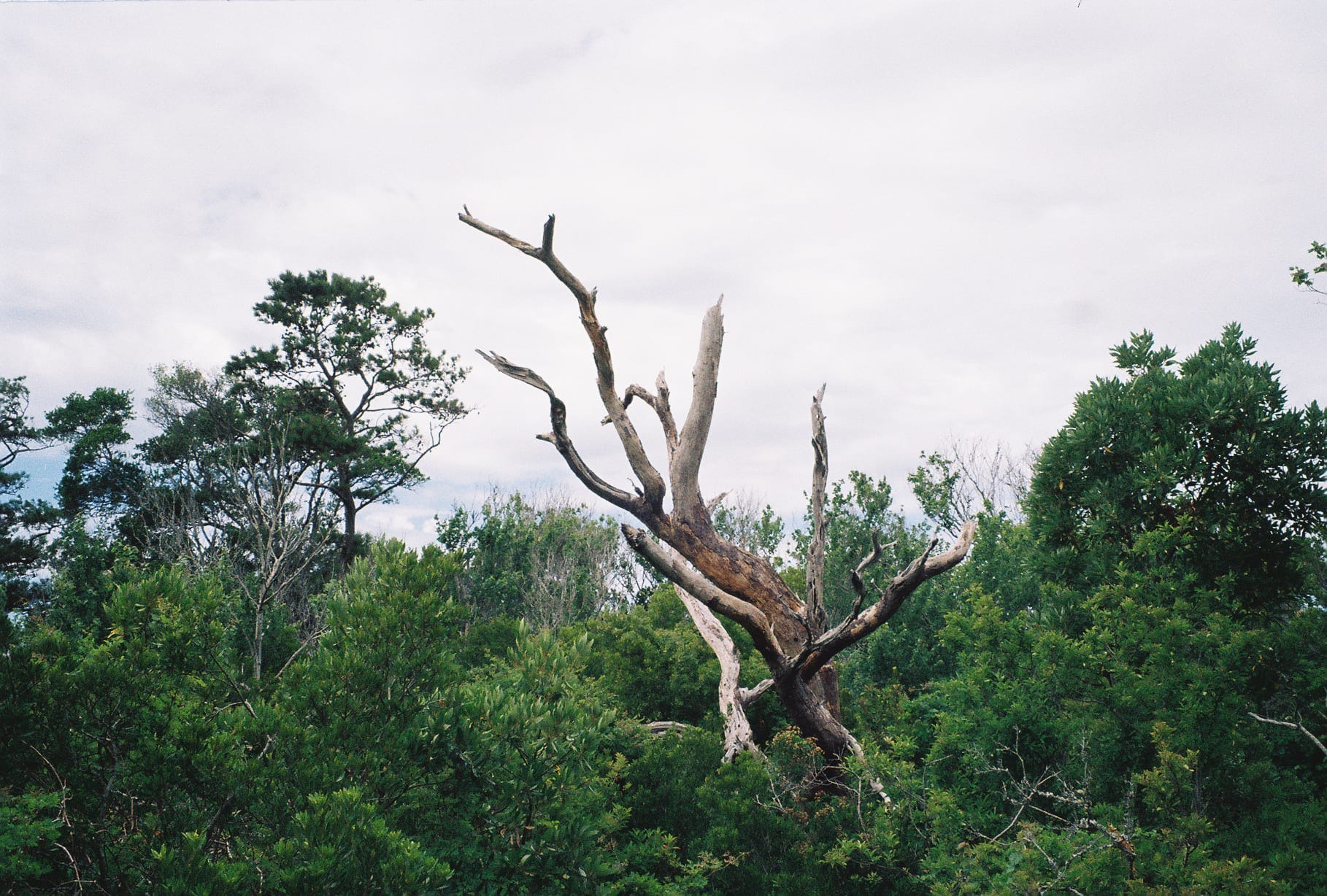
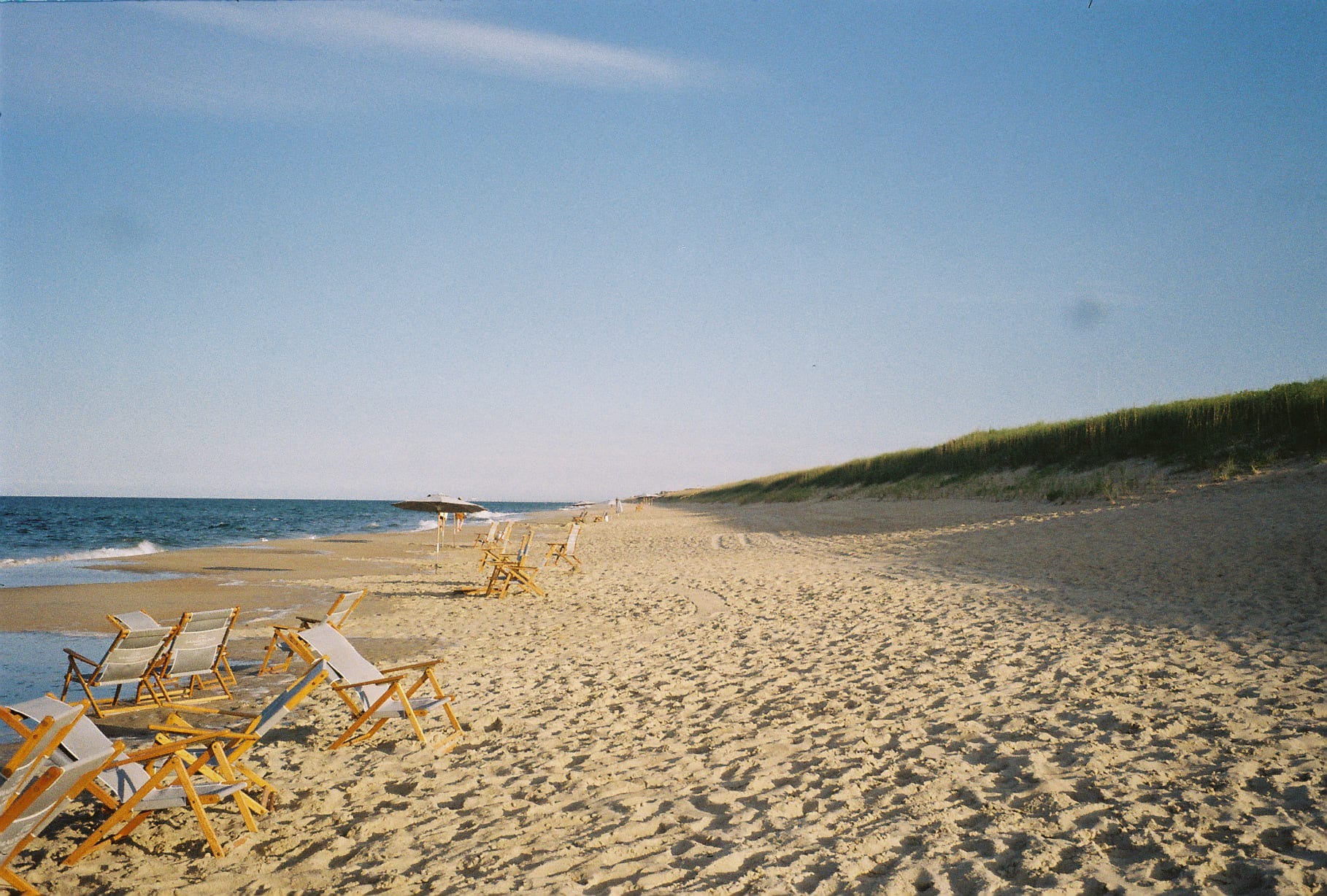
I’ve spent the summer doing something I haven’t done in nearly twenty-years. I’m shooting film again! At the beginning of the summer, I finally stopped into the camera shop near my home and picked up an old Ricoh Shotmaster point-and-shoot and a few rolls of film. For the last few months, I’ve been making photographs almost exclusively on film for the first time since I was in high school and it’s really been a blast. I wrote some notes about returning to film on the blog and all the photos in this issue are from my first roll. I’m continuing to post the roll over on jarrettfuller.photo too.
My birthday was at the beginning of the month and I spent the day in Philadelphia, a city I grew up outside of and one I still love. The highlight on this trip was a visit to Calder Gardens, the new museum/garden/showcase for Alexander Calder’s sculptures and mobiles. It was a really transporting experience that reminded me of the Noguchi Museum in Queens. I posted a bunch of photos of the space here. Garden Envy!!
Here’s a weird a challenge I gave myself: I wanted to make a playlist that felt like the long days of summer. I knew it had to open with the new Rostam track “Like a Spark” and I wanted it to end with Bruce Hornsby’s “Take a Light Strain”. I spent entirely too much time looking for 13 songs to connect them. The resulting playlist, available on Spotify, mixes folk, instrumental, indie, and slacker rock. Somehow it works? You can listen to it here and find all my other playlists collected on my website.
I’m not recording new episodes of Scratching of Surface but that doesn’t mean we’re not posting new content over on our Substack. Here’s are our latest posts:
In our new BOOK REVIEW column, I interviewed James Dyer and Nick Deakin about their new book, Ninety-Nine Graphic Design Workshops. I was lucky to have a workshop included in the book but it was nice to talk to them about their larger thesis around the role of graphic design.
For our members-only newsletter, I caught up with Dallas Morning News architecture critic (and new Pulitzer winner!) Mark Lamster about his upcoming book, Welcome to Paradox City: A Critical History of Dallas as Told Through Its Architecture.
I was pleased to published an exclusive excerpt from Danial Jonas Roche and Andrew Santa Lucia’s new book, Antifascist Architecture. The essay we published is called Another Architecture is Probable.
Scratching the Surface continues to be made possible from supporters of our Substack. For $5/month or $50/year, you get access to our newsletter archives, bonus interviews, and help keep the show free for everyone. I’d love to have you join us!
I found OnlyFantasy, the new podcast from Slow Burn creator Leon Neyfakh and comedian and OnlyFans creator Gracie Canaan completely fascinating. In the tight six-part series, Leon and Gracie try to understand the economics of OnlyFans but also explore companionship, love, and intimacy in the digital age. Highly recommend.
At the risk of too much sex in this issue, here’s a paragraph from Elizabeth Kolbert’s recent New Yorker story, “What’s The Point of Sex Anyway?”:
Lents opens with the example of clown fish, of “Finding Nemo” fame. Clown fish, which hide out among the tentacles of sea anemones, live together in tight-knit, highly regimented groups known as queues. Every queue has exactly one female, who is the biggest fish in the group and runs the show. Next in line is her mate. He’s the second-largest fish and the group’s only sexually mature male. The rest of the fish are stuck, Peter Pan-like, in a state of arrested development. If a queue loses its female, it rearranges itself. Her partner undergoes a sex change and takes on the role of the breeding female. His position is assumed, in turn, by the largest of the immature fish, who, thanks to the tragedy, finally gets to grow up. Were “Finding Nemo” true to life, when Nemo’s mother is eaten by a barracuda, his father, Marlin, would begin to transition. By the time Marlin and Nemo are, at long last, reunited, the change would be complete, and, in the absence of a larger male, Nemo would mate with his now-female father. “It’s probably a good thing that Pixar wasn’t striving for biological accuracy,” Lents observes.
This was the interesting fact I told everyone around me for a good two weeks!
Maybe you knew this, but I did not know that Nathaniel Rich, one of our best climate writers, is also a novelist. His new novel, Cloudthief, is a crime novel that centers on two thieves trying to break into a data center to steal its data. I can’t wait to read it! The New York Times has a companion story to the novel, where Rich explores a real-life data center heist.
In The Atlantic, Ian Bogost writes about the rise and fall of the Boeing 747 and what its retirement says about American culture and traveling generally.
Also in The Atlantic, Spencer Kornhaber profiles Holly Herndon and Mat Dryhurst, trying to understand the implications of AI on art and art making. I’m generally interested in Herndon’s work but share Kornhaber’s distrust of it all. I appreciated his conflicted — dare I say, ambivalent — conclusion to the piece.
Earlier in the month, when all eyes were on a building in Midtown Manhattan, that was at the risk of collapsing, Christopher Hawthorne turned me on to a 1995 New Yorker story, titled The Fifty-Nine-Story Crisis, about the time the Citicorp Center building was improperly engineer and risked collapse. I’d never read the story but loved reading it today. As author Joseph Morgenstern writes “This is a story with only heroes.” In his newsletter Punch List, Hawthorne got on a call with Morgenstern, now 93, to talk about how he came to write the story and what he learned from it.
Christian Solorzano very kindly invited me on Underscore, the Chicago Design Club podcast. He came with questions I wasn’t expecting, from thinking about questions to photography to what makes graphic design graphic design. I enjoyed it, maybe you will to?
Even though the semester is starting in less than a month, this also marks going-into-press mode for my upcoming book, Graphic Designers After Graphic Design. If you want to write about the book, or interview me, or do something together, let me know! It comes out September 29th!
Aside from that, I’m going heads down for the next few weeks: to prepare for classes but also to get started on some new projects and wrap up some others. Some fun things coming up. More soon!
Thank you, as always, for following along!
J